
Guides
The Modern Guide to Indoor Golf
The technology is settled. What separates venues now is everything around it.
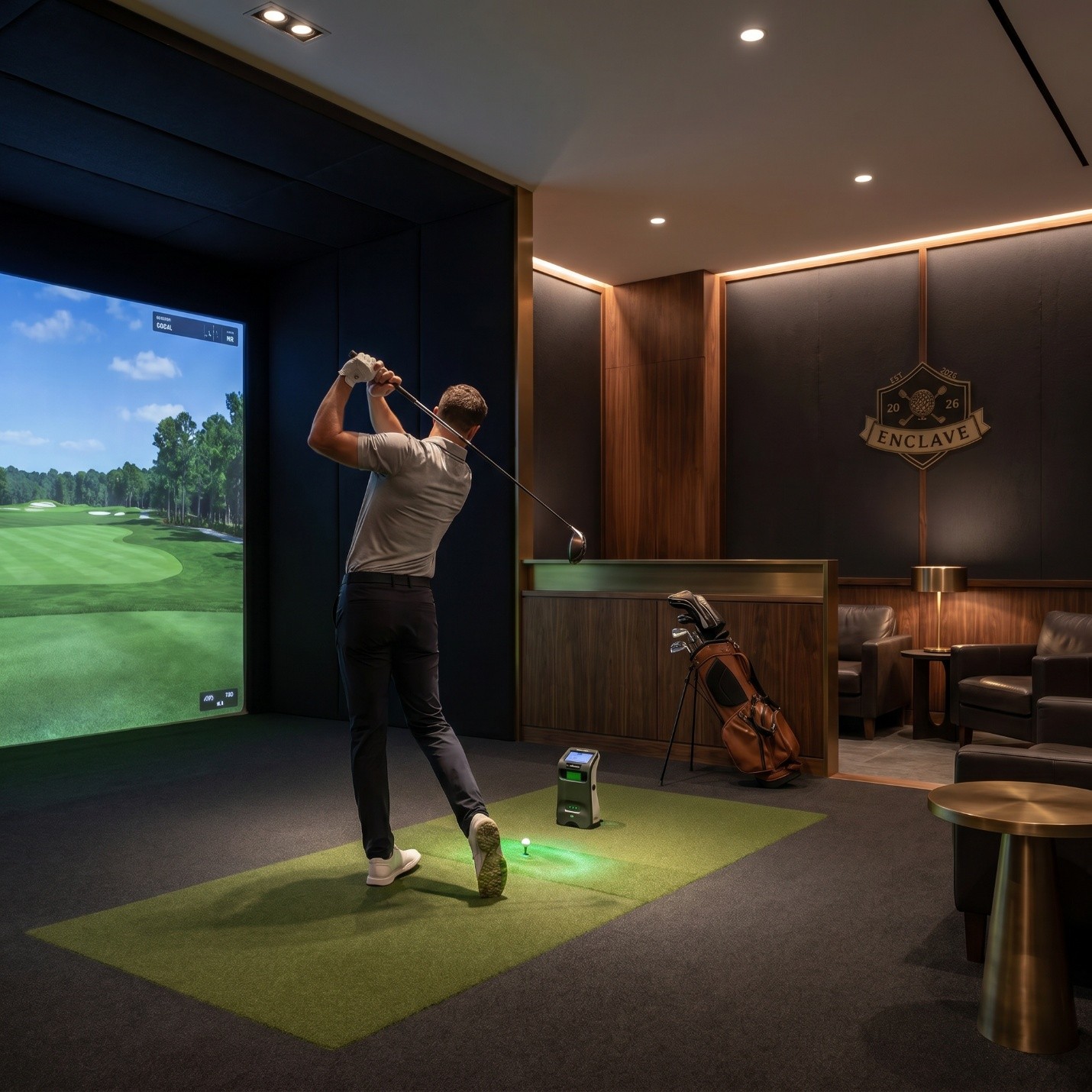
Indoor golf has moved from novelty to a normal part of how people play. The equipment question is largely settled. What remains worth understanding is how the technology works, how to use it well, and how to tell venues apart.
How the technology works
Two approaches dominate.
Radar tracks the ball in flight using doppler measurement. It reads ball speed, launch angle, spin, and club delivery with high accuracy and generally prefers a little space behind the hitting area.
Camera-based photometric systems capture high-speed images at impact and calculate flight from those measurements. They work in tighter rooms and read spin directly rather than inferring it.
Both are accurate enough that the numbers can be trusted. Neither is meaningfully better for a recreational player.
The numbers that actually matter
Modern systems produce thirty or more data points, and most of them are noise for most players. Four are worth watching.
- Carry distance. How far the ball actually flies. This is the only distance number that matters for club selection.
- Ball speed. The clearest measure of strike quality. It improves when you hit the middle, not when you swing harder.
- Launch angle. Too low and the ball does not carry. Too high and it costs distance.
- Face angle and path. Together these explain your curve. Almost every persistent slice or hook is visible here.
Ignore the rest until those four are consistent.
Practising well indoors
The great advantage indoors is feedback and repetition. The great risk is mindless repetition.
Some principles that hold up:
- Practice with a target. Hitting balls without one builds nothing.
- Change clubs regularly. Twenty consecutive seven irons teaches a pattern you will never face on a course.
- Play holes, not ranges. Consequence changes how you swing.
- Work on one thing per session. Two changes at once produce neither.
What indoor golf does not replicate
Honesty here is useful. Short game and putting are the weakest areas: no read, no genuine turf interaction, no true rollout. Uneven lies are absent. Wind, when simulated, is approximate.
Full swing, distance control, and club fitting translate very well. Anything within forty yards translates poorly.
Choosing a venue
Once the technology is adequate, and it usually is, the differences are entirely about the room. The useful questions:
- Where does the group sit, and can everyone see and talk?
- Is the lighting comfortable for two hours?
- Can you hold a conversation while someone is playing?
- Is the food and drink good enough to be judged on its own?
- Is the room designed for turnover or for staying?
These determine whether an hour of golf is a transaction or an evening.
Nearby
Enclave is a private indoor golf and social club being built in East Cobb, Georgia, with private suites designed as rooms rather than bays. It is not yet open.
Questions
- Is indoor golf accurate?
- Modern systems measure ball flight directly and are accurate enough that the numbers can be trusted for practice and club fitting. Short game and putting remain the weakest areas.
- Do I need my own clubs?
- Most venues provide clubs, though players working on their game generally prefer their own.
Continue Reading